
Testimony: Caps Do Not Work; National Data and the Maryland Experience
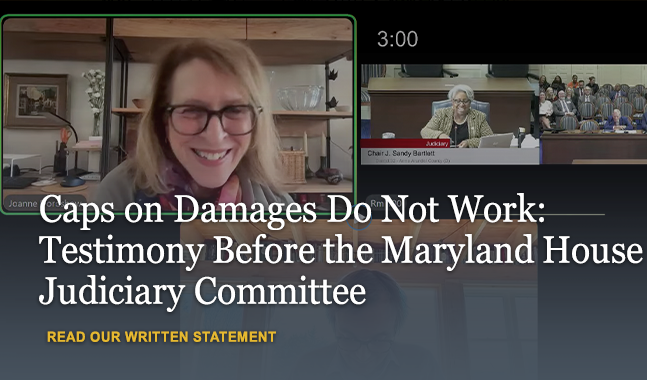
CAPS ON DAMAGES DO NOT WORK
NATIONAL DATA AND THE MARYLAND EXPERIENCE
(Submitted by Joanne Doroshow, Executive Director, October 13, 2026)
The Center for Justice & Democracy and its project, Americans for Insurance Reform (CJD/AIR), have been exploring the effect of caps on liability insurance since 1999.
U.S. INSURANCE CRISES AND MARYLAND’S RESPONSE
Three times in the last 50 years, the country experienced a severe liability insurance "crisis” that made insurance unaffordable or, in some cases, unavailable at any price for businesses, professions, homeowners and others. These periods are also known as “hard markets.” Each crisis was followed by periods of insurance rate stability, also known as “soft markets.” (Although a new hard market began shortly before the pandemic, it has developed far more slowly than in previous crisis years.[1])
Every time the industry raises rates, it blames lawyers, lawsuits, victims and juries, and tells lawmakers that passing “tort reform” is the only way to reduce premiums.
Crisis #1: The first liability insurance crisis hit the United States in the mid-1970s, precipitating the first wave of “tort reform” in medical malpractice insurance and product liability insurance particularly. Between 1975 and 1977, at least half the states enacted laws restricting injured patients’ and consumers’ rights to sue.[2] The insurance crisis ended in 1977 and was followed by a decade of stable rates, or a soft market, in all states.
Crisis #2: A more severe crisis took place in the mid-1980s, when most liability insurance was impacted. Many could not find coverage at any price. Between 1985 and 1989, some 46 states passed “tort reform” laws.[3] It was during this period that Maryland enacted its cap on non-economic damages. This crisis was followed by stable rates nationwide until approximately 2002.[4]
Crisis #3: In the early 2000s, the country experienced a third liability insurance crisis particularly for doctors. This crisis lasted from approximately 2002 to 2006. Lawmakers in at least half the states responded by passing laws limiting patients’ legal rights.[5] Despite having enacted a severe cap on damages in the mid-1980s, premiums for Maryland doctors rose significantly between 2002 and 2006—reportedly more than 70 percent over two years.[6] Marylandwas targeted by the American Medical Association (AMA) as a crisis state.[7] Rather than repealing the cap for failing to lower rates, lawmakers froze its dollar amount and paused cost-of-living adjustments, keeping the cap lower than it otherwise would have been.
THE FAILURE OF “TORT REFORM” TO CUT INSURANCE PRICES
Since 1999, we have produced a series of studies trying to answer two related questions: Do insurance rates drop after a state enacts “tort reform”? And do rates rise in states that refuse to strip away victims’ rights?
Working with actuary J. Robert Hunter, former Texas Insurance Commissioner and Federal Insurance Administrator under Presidents Ford and Carter, our studies examine pure premiums, also known as “loss costs.” Loss costs make up the largest share of the premium dollar and are the only component of an insurance rate that should be affected by verdicts, settlements, payouts or so-called “tort reform.”[8]
- Premium Deceit: The Failure of “Tort Reform” to Cut Insurance Prices (1999)
CJD/AIR’s first study, Premium Deceit (1999), examined insurance rates about a decade after the mid-1980s insurance crisis—when Maryland first enacted caps—testing the impact of “tort reforms” passed by state legislators (or voters by ballot initiative) during the mid-1980s.[9]
Premium Deceit found that enactment of “tort reform” laws had no impact on rates. More specifically, tort law limits enacted in response to the liability insurance crisis of the mid-1980s did not lower insurance rates in the ensuing years. States with few or no tort law restrictions experienced approximately the same changes in insurance rates as those states that enacted severe restrictions on victims’ rights. Simply put, there was no correlation between “tort reform” and insurance rates.
We concluded our study by noting even more striking findings:
[S]ome states that have resisted any “tort reform” since 1985 have experienced low increases in insurance rates/loss costs relative to the national trends, and some states that enacted major “tort reform” packages have seen very high rate/loss cost increases relative to the national trends.
For instance, in General Tort [i.e., not limited to Products Liability or Medical Malpractice laws], Massachusetts had no tort law changes in the period of study but had an increase in rate/loss cost of only 25.9% for the 14 year period, averaging 1.8% a year, well below general inflation. Massachusetts enjoyed the 10th lowest increase in the nation.
New Jersey, on the other hand, adopted severe tort law changes such as joint and several liability, collateral source and a cap on punitive damages. Yet New Jersey had a rate/loss cost increase of 82.7% (or 4.7% a year, 2.6 times the rate of change in Massachusetts). New Jersey suffered the eighth highest cost increase in the nation during the 1985 to 1998 period.
It was clear that factors other than changes in the tort law were responsible for these results. Moreover, these findings were consistent with other studies, such as the 1991 report from Washington’s Insurance Commissioner Dick Marquardt, who found that it was “impossible to attribute stable insurance rates to tort-law changes or the damages cap,” since rates also improved in states that did not pass tort reform.[10]
When asked to comment on the Premium Deceit findings, Sherman Joyce, President of the American Tort Reform Association (ATRA), told Liability Week on July 19, 1999, “We wouldn’t tell you or anyone that the reason to pass tort reform would be to reduce insurance rates.” ATRA General Counsel Victor Schwartz told the same publication, “[M]any tort reform advocates do not contend that restricting litigation will lower insurance rates, and I’ve never said that in 30 years.” And when Premium Deceit was reissued in 2002, Debra Ballen, American Insurance Association Executive Vice President, responded in a March 13, 2002 news release, “Insurers never promised that tort reform would achieve specific savings.”
- True Risk: Medical Liability, Malpractice Insurance and Health Care
In 2009, CJD/AIR produced a second study, True Risk,[11] providing an initial look at the insurance crisis that occurred from 2002 to 2006, which hit medical malpractice insurance lines most severely. Once again, the study found that despite what the insurance industry and medical lobbies promised lawmakers, legal limits on injured patients had not lowered insurance rates in the ensuing years. States with few or no restrictions on patients’ legal rights experienced the same level of insurance rate changes as those states that enacted severe limits on patients’ rights.
- Premium Deceit 2016: The Failure of “Tort Reform” to Cut Insurance Prices
A decade following the end of that third liability insurance crisis, CJD/AIR updated its prior studies with Premium Deceit 2016.[12] This new study sought to determine if “tort reforms” enacted in nearly half the states in the years 2002 through 2005 delivered their intended effect—lowering rates for doctors—compared to the states that did not restrict tort laws and protected the legal rights of patients. We also specifically examined the impact of non-economic damages “caps.” Notably, 14 states either enacted new caps during this crisis period or created new limits on their caps. Maryland was in that category.
Once again, our findings showed that the “tort reform” remedies pushed by the insurance industry failed to lower rates. With soft market conditions firmly established across the country in 2016, we found that states that enacted new limits on patients’ legal rights in medical malpractice cases saw an average 22.7 percent decrease in pure premiums (lost costs) from 2002 to the present—but states that did nothing saw a larger average drop of 29.4 percent. What’s more, states that enacted or lowered their caps on non-economic damages saw an average 21.8 percent decrease in pure premiums (lost costs) over the period—but the states that did not saw an even greater average drop of 28.9 percent.
- Subsequent Outside Studies Have Yielded Similar Results
In a 2023 article titled The Dark Side of Insurance, University of Texas and Tel Aviv University Law Professor Ronen Avraham and Tel Aviv University President Ariel Porat cited Maryland’s experience, among others, writing:[13]
[E]mpirical studies reveal premium increases after states enact damage caps. For instance, after Oklahoma passed insurer-supported damages caps, medical malpractice premium rates increased by 83 percent. Likewise, in Maryland, Missouri, and other states, insurers lobbied for damage caps claiming that they would reduce premiums. Ultimately, rates increased after legislature enacted reforms. Other studies support this conclusion, finding that caps above $750,000 increase premiums substantially.
In a study published in 2022 titled How Do Insurers Price Medical Malpractice Insurance? by Northwestern University Law School and Kellogg School of Management Professor Bernard S. Black, Federal Deposit Insurance Corporation Financial Economist Jeffrey Traczynski and U.S. Census Bureau Senior Economist and Program Manager Victoria Udalova, the authors wrote:[14]
The insurance market “seems, in important ways, to defy economic logic.” For example, “as caps drive down insurer costs, premia do not fall in parallel with costs, leading to rising premia/cost ratios. These persist through the end of our sample period, well over a decade after the early 2000s wave of cap adoptions. We also find evidence for reverse causality, with a rising Premium/Cost Ratio predicting cap adoption.” Instead of reducing premiums, caps lead to “sustained supranormal profits.”
In a 2020 article titled The Impact of Medical Malpractice Reforms by Georgetown University Law Professor David A. Hyman and East China University of Political Science and Law Associate Professor Jing Liu, the authors found after conducting “a comprehensive review of available data and scholarly literature”:[15]
[B]ecause malpractice claiming does not appear to be the cause of med mal crises, litigation-focused remedies are likely to be incomplete, underpowered, and inefficient in addressing what is, in the end, a problem in the market for med mal insurance.
THE CAUSE OF INSURANCE RATE INCREASES
In early March 2020—days before the COVID pandemic hit—the Center for Justice & Democracy (CJ&D) and Consumer Federation of America (CFA) released How the Cash Rich Insurance Industry Fakes Crises and Invents Social Inflation.[16] At that point in time, businesses were seeing insurance rates increase after 13 years of low or stable rates. The CJ&D and CFA study documented in significant detail how the overcapitalized property/casualty insurance industry was charging many businesses far too much in premiums while threatening even greater increases, all while attempting to create the false perception that it was too financially troubled to pay claims. The report also examined the history of the insurance industry’s economic cycle and showed that insurers have not been forthcoming about the causes of sharp premium increases that led to prior insurance crises.
Put simply, premiums rise and fall in sync with a well-established cycle and do not reflect trends in paid claims. In fact, we showed that adjusted paid claims had stayed essentially flat for the prior two decades while premiums went up and down in sync with the insurance industry’s economic cycle.
The insurance industry’s boom-and-bust cycle stems from insurers’ reliance on investment income for most of their profits. They invest the “float” that occurs during the time between when premiums are paid to the insurer and losses are paid out by the insurer—e.g., there is about a 15-month lag in auto insurance, while there is a 5- to 10-year lag in “long tail” lines like medical malpractice.[17](As a corollary to this, rarely do insurers achieve an underwriting profit, i.e., when premiums taken in are more than “losses” and underwriting expenses. In many lines of insurance, an underwriting profit would produce a wildly excessive overall profit because the investment yield on the float is so great.)
During years of a strong stock market, high interest rates and/or excellent insurer profits, insurance companies engage in fierce competition for premium dollars to invest for maximum return. This competitive underpricing of policies results in a soft market.
For example, in the decade before How the Cash Rich Insurance Industry Fakes Crises and Invents Social Inflation was released in 2020, the industry’s own data showed that total commercial insurance payouts had not spiked and generally tracked the rate of inflation and growth of population. In order to increase premiums in 2019, insurers used an accounting trick to inflate their “incurred losses”[18] by increasing or padding reserves—the money set aside to pay claims—despite, at the same moment, experiencing no increase in payouts or any trend suggesting large future payouts. This “over-reserving” is part of a decades-long pattern, often politically inspired and used by insurers as a way to show poor income statements, which it then uses to falsely claim large “losses” and, in turn, to justify imposition of large premium increases.
As we showed in our 2020 and 2023 reports,[19] adjusted losses (i.e., after making reasonable adjustments for inflation, population growth and mileage driven for auto) stayed generally flat or increased relatively little. What’s more, these losses actually decreased in three major areas of commercial insurance: Commercial Multi-Peril, Commercial Auto Liability and Medical Malpractice.
We also found that during the prior hard market (2002 to 2005), insurers offering specific commercial lines of coverage overestimated their annual claim-related losses by 16.9%. Adjusted premiums grew faster (or shrunk less) than losses. As for Medical Malpractice, our evidence showed clearly that doctors were price-gouged during the 2002 to 2005 hard market. Doctors paid increasingly high premiums while paid claims actually dropped. Medical malpractice insurers were misrepresenting their actual losses by an incredible annual average of 33%.
RECENT FLORIDA EXPERIENCE
Florida does not cap non-economic damages. The Florida Supreme Court found caps to be unconstitutional in three major decisions.[20] In the 2014 case Estate of McCall v. United States, the court directly challenged the insurance industry’s justification for caps, stating:
Thus, available data indicates the [legislative] Task Force’s finding that noneconomic damage awards by juries are a primary cause of the purported medical malpractice crisis in Florida is most questionable.… The Task Force recognized that there are other explanations for the dramatic rise in medical malpractice insurance premiums.… The available evidence fails to establish a rational relationship between a cap on noneconomic damages and alleviation of the purported crisis.
While the state does not cap non-economic damages, it has enacted a variety of other “tort reforms” beginning in the 1980s and throughout the subsequent decades.[21]
Four years ago, Florida decided to respond to the state’s homeowners insurance crisis by making it harder for policyholders to sue insurance companies with various types of “tort reform.” Since then, the insurance industry has been insisting that Florida’s approach has “worked” and is aggressively lobbying for it elsewhere.
The Center for Justice & Democracy’s new Backgrounder, The Tort Reform Blunder: What Voters Know and Florida Learned, draws on recent reporting demonstrating what is now clear: “Tort reform” has not “worked” and voters and policyholders are well aware of it.[22]
NOTES
[1]See J. Robert Hunter, Joanne Doroshow and Douglas Heller,Consumer Federation of America and Center for Justice & Democracy, Inventing Social Inflation 2023 (2023), https://centerjd.org/content/inventing-social-inflation-2023; J. Robert Hunter, Joanne Doroshow and Douglas Heller,Consumer Federation of America and Center for Justice & Democracy, How the Cash Rich Insurance Industry Fakes Crises and Invents Social Inflation (2020), https://centerjd.org/content/study-how-cash-rich-insurance-industry-fakes-crises-and-invents-social-inflation
[2]See Appendix, J. Robert Hunter, Joanne Doroshow and Douglas Heller,Consumer Federation of America and Center for Justice & Democracy, How the Cash Rich Insurance Industry Fakes Crises and Invents Social Inflation (2020), https://centerjd.org/content/study-how-cash-rich-insurance-industry-fakes-crises-and-invents-social-inflation
[3] Ibid.
[4] Ibid.
[5] Ibid.
[6] James Dao, “A Push in States to Curb Malpractice Costs,” New York Times, January 14, 2005, https://www.nytimes.com/2005/01/14/us/a-push-in-states-to-curb-malpractice-costs.html
[7] “AMA Calls for Medical Liability Reform at Maryland Rally,” Claims Journal, January 22, 2004, https://amp.claimsjournal.com/news/east/2004/01/22/35976.htm
[8] Pure premium data are compiled by a private company called the Insurance Services Office (ISO), which has the largest database of audited, unit transaction insurance data of any entity in the United States. ISO provides these data to states to use in setting rates. The term is used interchangeably with “loss costs.” It is the portion of each premium dollar taken in that insurance companies use to pay for claims. It includes the cost of adjusting and settling claims, including adjuster and legal expenses. Insurers use other parts of the premium dollar to pay for their profit, commissions, other acquisition expenses, general expenses and taxes. Loss costs include both paid and outstanding claims (reserves are included through an actuarial process known as “loss development”) as well as trends into the future since rates based on ISO loss costs are for a future period. Thus, loss costs include ISO’s adjustments to make sure that everything is included in the price, even such factors as future inflation.
[9]J. Robert Hunter and Joanne Doroshow, Center for Justice & Democracy, Premium Deceit: The Failure of “Tort Reform” to Cut Insurance Prices (1999, 2002), http://centerjd.org/system/files/PremiumDeceit.pdf
[10] “Health Care Reform – Bush’s Insurance Cap Plan A Proven Failure,” Seattle Times, May 16, 1991.
[11] J. Robert Hunter, Gillian Cassell-Stiga and Joanne Doroshow, Americans for Insurance Reform, True Risk: Medical Liability, Malpractice Insurance and Health Care (2009), https://centerjd.org/content/study-true-risk-medical-liability-malpractice-insurance-and-health-care
[12]J. Robert Hunter and Joanne Doroshow, Americans for Insurance Reform, Premium Deceit 2016: The Failure of “Tort Reform” to Cut Insurance Prices, https://www.centerjd.org/content/premium-deceit-2016-failure-tort-reform-cut-insurance-prices
[13] Ronen Avraham and Ariel Porat, “The Dark Side of Insurance,” 19 Rev. L.& Econ. 13 (February 2023), https://www.degruyter.com/document/doi/10.1515/rle-2022-0054/html
[14] Bernard S. Black, Jeffrey Traczynski and Victoria Udalova, “How Do Insurers Price Medical Malpractice Insurance?” IZA Institute of Labor Economics Discussion Paper (June 2022), https://papers.ssrn.com/sol3/papers.cfm?abstract_id=4151271
[15] David A. Hyman and Jing Liu, “The Impact of Medical Malpractice Reforms,” 16 Ann. Rev. L. & Soc. Sci. 405 (October 2020), https://www.annualreviews.org/doi/abs/10.1146/annurev-lawsocsci-060120-093911
[16]J. Robert Hunter, Joanne Doroshow and Douglas Heller, Consumer Federation of America and Center for Justice and Democracy, How the Cash Rich Insurance Industry Fakes Crises and Invents Social Inflation, (2020), https://centerjd.org/content/study-how-cash-rich-insurance-industry-fakes-crises-and-invents-social-inflation
[17] Indeed, Warren Buffett pointed to the float as a key factor in his strategy of owning insurance companies. See, e.g., Warren Buffett, Letter to Berkshire Hathaway Shareholders, February 23, 2019, https://www.berkshirehathaway.com/letters/2019ltr.pdf (“One reason we were attracted to the P/C business was the industry’s business model: P/C insurers receive premiums up front and pay claims later.… This collect-now, pay-later model leaves P/C companies holding large sums – money we call ‘float’ – that will eventually go to others. Meanwhile, insurers get to invest this float for their own benefit.”)
[18] When a company has an “incurred loss,” this does not mean the insurer has actually paid out this money. This figure includes not just paid claims but estimates of future claims that they know about (reserves) and claims they do not even know about yet, called “incurred but not reported” (IBNR). Some of these claims may not even exist and others may take years for payout to occur. It is this figure that insurers file with state insurance departments when seeking rate hikes. The excess reserves used to justify rate increases are later, during the soft market, released into the insurer profit accounts.
[19]J. Robert Hunter, Joanne Doroshow and Douglas Heller,Consumer Federation of America and Center for Justice & Democracy, Inventing Social Inflation 2023 (2023), https://centerjd.org/content/inventing-social-inflation-2023; J. Robert Hunter, Joanne Doroshow and Douglas Heller,Consumer Federation of America and Center for Justice & Democracy, How the Cash Rich Insurance Industry Fakes Crises and Invents Social Inflation (2020), https://centerjd.org/content/study-how-cash-rich-insurance-industry-fakes-crises-and-invents-social-inflation
[20]North Broward Hospital District v. Kalitan, 219 So. 3d 49 (Fla. 2017); Estate of McCall v. United States, 134 So. 3d 894 (Fla. 2014); Smith v. Department of Insurance, 507 So. 2d 1080 (Fla. 1987).
[21]See Appendix, J. Robert Hunter, Joanne Doroshow and Douglas Heller,Consumer Federation of America and Center for Justice & Democracy, How the Cash Rich Insurance Industry Fakes Crises and Invents Social Inflation (2020), https://centerjd.org/content/study-how-cash-rich-insurance-industry-fakes-crises-and-invents-social-inflation; Appendix, J. Robert Hunter and Joanne Doroshow, Center for Justice & Democracy, Premium Deceit: The Failure of “Tort Reform” to Cut Insurance Prices (1999, 2002), http://centerjd.org/system/files/PremiumDeceit.pdf
[22]See Center for Justice & Democracy, “The Tort Reform Blunder: What Voters Know and Florida Learned,” October 12, 2026, https://centerjd.org/content/backgrounder-tort-reform-blunder-what-voters-know-and-florida-learned